When you purchase through links on our site, we may earn an affiliate commission. Here’s how it works.
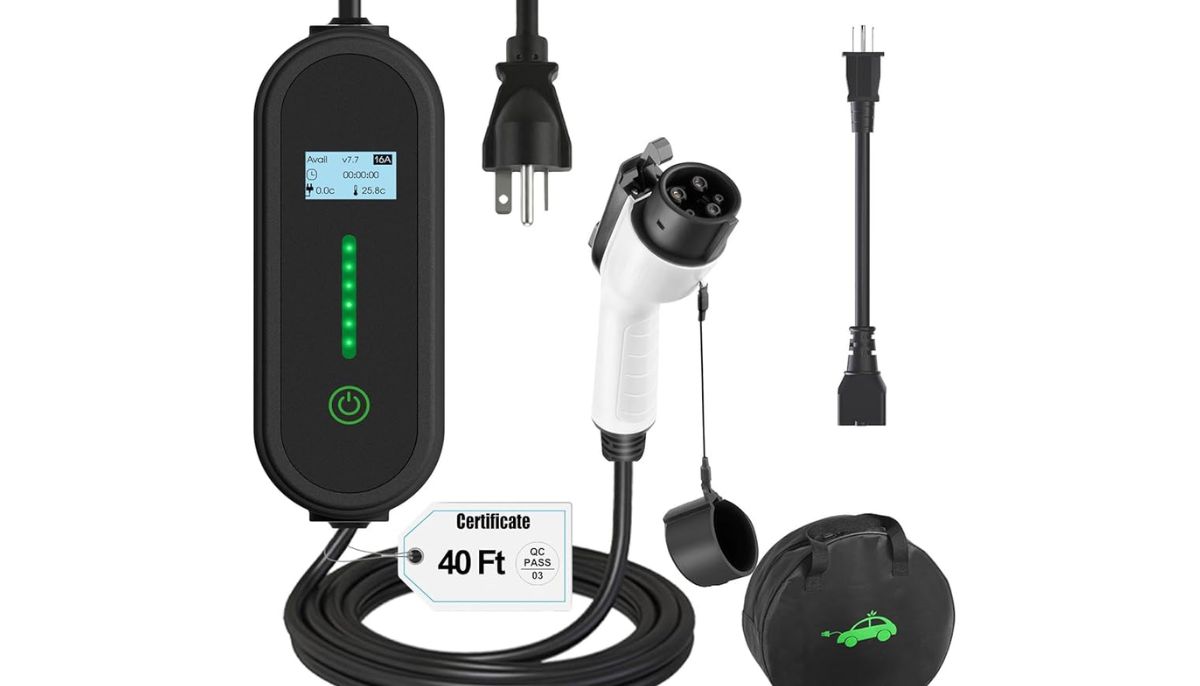
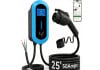
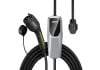
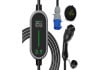
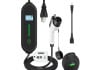
The ENERGYGENIE 16Amp Portable EV Charger enters the residential automotive accessory market as a highly accessible and flexible power solution designed for drivers who want a straightforward, daily charging option.
Engineered to operate on both Level 1 and Level 2 electricity lines, this versatile system seamlessly transitions from slow domestic 110V top-ups to faster 240V charging sessions.
Instead of relying on a permanent and expensive wall station, it ships with standard NEMA 5-15 and NEMA 6-20 adapter plugs, allowing motorists to establish a charging point virtually anywhere a compatible mains socket is available.
Specifications
-
ASIN: B0CGQHQL1Q
-
Manufacturer: ENERGYGENIE
-
Voltage: Dual-voltage 110V / 240V AC
-
Amperage: Up to 16 Amps
-
Plug type: NEMA 6-20 (with NEMA 5-15 adapter included)
-
Connector type: Universal SAE J1772 standard
-
Display: LED indicator lights (no digital screen)
-
Item weight: 6.6 lbs (approx. 2.99 kg)
-
Safety features: Lightning, leakage, overvoltage, overheating, and overcurrent protections
Performance
The ENERGYGENIE 16Amp Portable EV Charger offers reliable everyday charging with the flexibility to operate on both 120V and 240V power sources.
Its 16A output delivers noticeably faster charging on a Level 2 outlet than a standard household socket, making it ideal for overnight charging and travel.
With plug-and-play operation, built-in electrical protections, and broad J1772 compatibility, it provides a safe, dependable, and hassle-free charging experience for most EV owners.
Reasons to buy
-
Outstanding dual-voltage flexibility: Ships with both NEMA 6-20 and NEMA 5-15 plugs, allowing you to charge from higher-voltage sockets or standard domestic household outlets.
-
Frictionless plug-and-play operation: Bypasses complicated companion smartphone apps and digital menus for instant charging the moment you connect it to your vehicle.
-
Excellent travel portability: The lightweight and compact design packs away effortlessly, making it the perfect emergency backup cable for frequent travellers.
-
Universal vehicle compatibility: Equipped with a standardised J1772 connector head, making it natively compatible with almost all mainstream electric cars and plug-in hybrids.
-
Robust safety protections: Features comprehensive internal safeguards, including overcurrent and lightning protection, to protect your car's battery health.
Reasons to avoid
-
Slow maximum charging speeds: Limited to a maximum of 16 Amps, making it unsuitable for drivers with high daily mileages who require rapid overnight battery replenishment.
-
Lacks smart wireless options: Operates entirely as an offline physical unit with no built-in Wi-Fi, Bluetooth, or app scheduling functionality.
-
Tesla models require a separate component: Because it uses a standard J1772 connector, Tesla drivers must supply their own external adapter to charge their vehicles.

Zainab Talha is a technology journalist specialising in electric vehicles, EV charging infrastructure, sustainable mobility, and emerging transportation technologies. Her reporting explores the innovations, policies, and industry developments driving the global shift towards cleaner and smarter mobility.
Her coverage spans the wider EV ecosystem, including charging networks, battery technology, renewable energy integration, smart mobility solutions, and government initiatives. She follows developments across automotive manufacturers, energy companies, charging providers, and technology firms to examine how new technologies are changing the way people travel and power their vehicles.
Beyond electric mobility, Zainab covers consumer technology, artificial intelligence, clean energy, connected devices, and digital transformation. She also has expertise in smart home and security technologies, reporting on deadbolts, smart locks, access control systems, surveillance devices, and connected security solutions.
Her work examines emerging technologies such as biometric authentication, remote access, IoT connectivity, and AI-powered security, with a focus on their practical applications and impact on consumers.
Known for her research-driven and accessible approach, Zainab translates complex technological developments into clear, engaging stories. Her reporting combines technical understanding with real-world context, helping readers navigate the rapidly changing worlds of mobility, technology, sustainability, and connected living.

 Jul 19, 2026