When you purchase through links on our site, we may earn an affiliate commission. Here’s how it works.
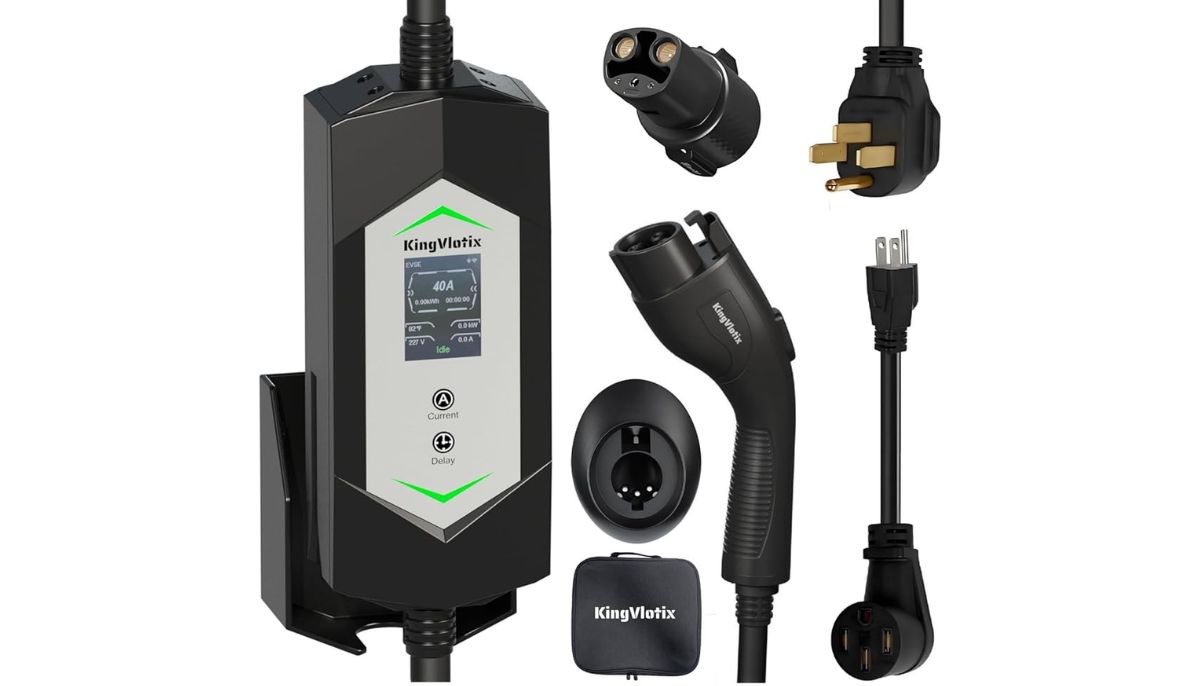
The KingVlotix 40 Amp Portable EV Charger enters the residential automotive accessory market as a highly versatile power solution engineered for electric vehicle drivers who want a single, adaptable tool for both daily home charging and emergency roadside use.
Operating as a flexible dual-voltage system, the unit features a native high-amperage NEMA 14-50 plug for rapid Level 2 performance alongside an included NEMA 5-15 adapter for standard Level 1 wall sockets.
This dual-plug architecture completely avoids the complex, permanent installation processes associated with hardwired wallboxes, serving as an exceptional primary home setup or a highly capable travel lead stowed away for long-distance trips.
Specifications
-
ASIN: B0FDQ3BLC4
-
Brand: KingVlotix
-
Model number: KIN-U-0001
-
Voltage support: 120V (Level 1) / 240V (Level 2) Dual-Voltage
-
Amperage: Up to 40 Amps max (13A at 120V / 40A at 240V)
-
Plug type: NEMA 14-50 with NEMA 5-15 adapter
-
Connector type: SAE J1772 with included Tesla NACS adapter
-
Cable length: 25 ft cold-tolerant cable
-
Dimensions: 5.9 cm x 23.2 cm x 9.6 cm
-
Safety protections: Under-voltage, over-voltage, over-current, short circuit, leakage, and overheating safeguards
Performance
In real-world operation, the KingVlotix 40 Amp Portable EV Charger delivers the dependable charging performance expected from a premium portable Level 2 unit.
When connected to a dedicated 240V NEMA 14-50 outlet, its 40 Amp output provides up to 9.6 kW of charging power, allowing most modern EVs to gain approximately 30 to 36 miles of driving range per hour, depending on the vehicle's onboard charger and battery efficiency.
Reasons to buy
-
Excellent dual-voltage flexibility: Works across standard 120V household lines and rapid 240V utility circuits using the included smart adapters.
-
Inclusive Tesla adapter: Ships with a bundled J1772-to-Tesla NACS converter, eliminating the need to buy extra parts to charge a Tesla vehicle.
-
Substantial cold-resistant reach: The 25-foot heavy-duty cable maintains high flexibility in sub-zero climates to connect easily to rear charging ports.
-
Intelligent power adjustments: Automatically senses the line voltage and restricts maximum current levels to protect delicate domestic circuit breakers.
-
Convenient settings memory: Remembers your previously selected current configuration to ensure rapid, stress-free connectivity every time you plug in.
Reasons to avoid
-
Demands heavy-duty lines for full speed: Reaching the maximum 40-amp rapid delivery curve requires access to a pre-installed 240V NEMA 14-50 outlet.
-
Lacks wireless application features: Operates as an offline plug-and-play unit without integrated Wi-Fi or Bluetooth smartphone connectivity for remote session tracking.
-
Cable management requires space: The thick 25-foot charging cord is incredibly sturdy but can feel bulky to handle and stow away in constrained charging areas.

Zainab Talha is a technology journalist specialising in electric vehicles, EV charging infrastructure, sustainable mobility, and emerging transportation technologies. Her reporting explores the innovations, policies, and industry developments driving the global shift towards cleaner and smarter mobility.
Her coverage spans the wider EV ecosystem, including charging networks, battery technology, renewable energy integration, smart mobility solutions, and government initiatives. She follows developments across automotive manufacturers, energy companies, charging providers, and technology firms to examine how new technologies are changing the way people travel and power their vehicles.
Beyond electric mobility, Zainab covers consumer technology, artificial intelligence, clean energy, connected devices, and digital transformation. She also has expertise in smart home and security technologies, reporting on deadbolts, smart locks, access control systems, surveillance devices, and connected security solutions.
Her work examines emerging technologies such as biometric authentication, remote access, IoT connectivity, and AI-powered security, with a focus on their practical applications and impact on consumers.
Known for her research-driven and accessible approach, Zainab translates complex technological developments into clear, engaging stories. Her reporting combines technical understanding with real-world context, helping readers navigate the rapidly changing worlds of mobility, technology, sustainability, and connected living.

 Jul 12, 2026