Pareesa Afreen
  Dec 29, 2025
In 2025, the world saw just how deeply modern life is intertwined with a handful of digital systems and just how fragile those systems are. From cloud infrastructure to gaming networks, from social media and streaming platforms to telecom services, a series of unexpected outages upended everyday life for millions, showed single points of failure ripe for meltdown, and reignited concerns over the world's growing reliance on centralised cloud providers.
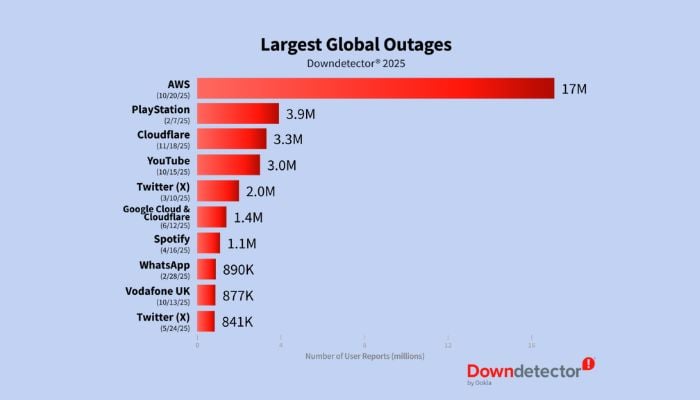
Data from Downdetector showed that the largest outages of 2025 were not isolated technical glitches but cascading failures that rippled across regions, industries, and economies.
AWS Outage: Biggest global digital failure of 2025
The worst global outage of the year struck on October 20, 2025, when Amazon Web Services had an extended disruption resulting in more than 17 million reports across Amazon-owned and dependent services.
The failure lasted for over 15 hours before it was discovered that it was because of a failure in the automated Domain Name System (DNS) management system, handling requests for the DynamoDB database service in the US-EAST-1 region. Single points of failure within one of the world’s most relied-upon cloud regions made the incident damaging.
While AWS struggled to get services back online, Snapchat, Netflix, and several e-commerce websites crumbled. In the case of users, it was an instantaneous hit: social feeds wouldn't load, streaming didn't work, checkouts on websites couldn't be completed, and businesses that had infrastructure backed by AWS were all but offline for most of the day.
The incident highlighted a growing industry concern: while cloud computing promises redundancy and resilience, concentration within specific regions can still trigger global disruption when something goes wrong.
PlayStation network: Gaming’s biggest blackout
The second-largest outage occurred in 2025 in an unexpected industry, gaming. On February 7, 2025, the PlayStation Network (PSN) went down with a network-wide downtime that left users locked out for more than 24 hours, logging 3.9 million reports worldwide.
Gamers could not connect to online games such as Call of Duty and Fortnite, which affected competitive gamers as well as individuals who produce content based on the availability of the internet.
According to Downdetector, this outage was a PlayStation Network issue with no major cloud service provider or internet service provider affected. It has become very apparent from the scope and duration of this outage that gaming networks are very centralised, and a single issue within a network could bring millions to a grinding halt.
Cloudflare outage
On November 18, 2025, the world witnessed its third-largest internet outage, which occurred as Cloudflare, an essential internet security, content delivery, and performance services provider, became disrupted.
This incident produced more than 3.3 million reports over the affected services, taking almost five hours to end. Since Cloudflare is at the core of the internet infrastructure supporting numerous apps, websites, and Application Programming Interfaces (APIs), this issue hampered everything from personal blogs to enterprise apps.
The disruption that happened highlighted the essential truth about the modern internet, namely that despite what looks like decentralisation, a very small set of internet infrastructure companies handles a vast amount of internet traffic.
Regional breakdown: Where outages hit hardest
While global outages dominated headlines, regional data reveals how disruptions played out differently across markets.
United States and Canada
North America experienced the highest concentration of high-impact outages, with several incidents surpassing one million reports.
- PlayStation Network (February 7): 1.6 million reports
- YouTube (October 15): 1.5 million reports during a global streaming issue
- AWS (October 20): 1.2 million reports
- Snapchat (October 20): 944,675 reports, largely tied to the AWS failure
- Starlink (July 24): 583,989 reports during a satellite internet disruption
- Verizon (August 30): 515,923 reports, highlighting continued telecom vulnerabilities
These outages affected not just entertainment but remote work, education, and critical connectivity services.
Europe (EU)
Europe’s largest outages reflected a mix of gaming, social media, and telecom failures.
- PlayStation Network (February 7): 1.7 million reports
- Snapchat (October 20): 989,559 reports
- Vodafone UK (October 13): 833,211 reports due to a non-malicious software issue with a vendor partner
- WhatsApp (February 28): 621,763 reports
- Spotify (April 16): 468,334 reports
- Odido (June 15 and 25): Two outages within 10 days totaling over 739,000 reports
The Vodafone outage, in particular, disrupted broadband, 4G, and 5G services, underscoring the cascading effects of vendor-side failures.
Asia Pacific (APAC)
In APAC, social media and cloud platforms dominated outage activity.
- X (March 10): 645,395 reports
- Snapchat (October 20): 399,108 reports
- YouTube (October 15): 245,087 reports
- AWS (October 20): 175,380 reports, with another AWS incident on April 15 adding 106,667 reports
The data reflects how deeply integrated global platforms are in everyday communication across the region.
Latin America (LATAM)
LATAM’s largest outages combined global platform failures with regional financial disruptions.
- YouTube (October 15): 183,672 reports
- AWS (October 20): 164,011 reports
- WhatsApp (February 28 and later): Over 144,000 combined reports across two outages
- Banco Itaú (October 6): 73,745 reports, marking a significant banking sector disruption
Financial platform outages raised particular concern due to their impact on payments and consumer trust.
Middle East and Africa (MEA)
In MEA, major disruptions came from telecom providers and global infrastructure services.
- Du (February 8): 28,444 reports
- Cloudflare (November 18): 28,016 reports
- Snapchat (October 20): 26,392 reports
Although there has been a lower volume of reported outages compared to other regions, these outages impacted basic connectivity within markets where redundant connectivity solutions may not be readily available.
Internet outages in 2025 threw this truth into sharp relief: The internet may seem infinite, but it's more and more dependent on centralised networks, which can have worldwide effects when they fail.
Cloud density, dependence on the cloud vendor, and overall platform size mean that when failures happen, they are bigger, longer, and more impactful than even the previous worst-case scenarios.
For companies, the year has been a reminder that business continuity planning can no longer be a nice-to-do but a must-do act. For end users, it is a reality check on the “always-on” nature of the Internet.