Dec 02, 2025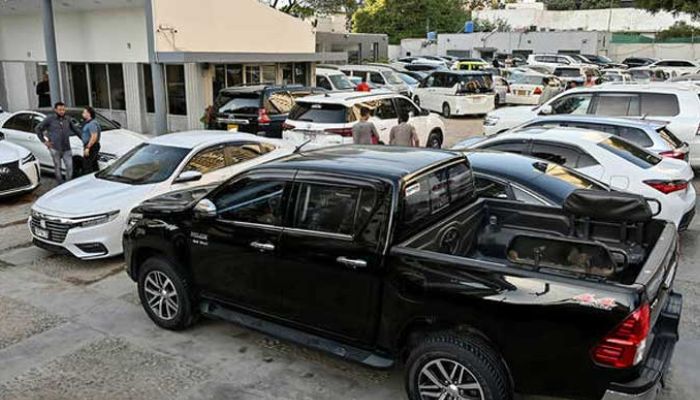
An undated image of vehicles parked at car dealer's showroom in Karachi. — AFP/File
The federal government is considering scrapping the Personal Baggage Scheme for importing used cars while tightening rules for the two remaining programmes on Tuesday.
Officials told The News that a summary has been forwarded to the Economic Coordination Committee (ECC) by Ministry of Commerce regarding the abolition of the baggage-based import scheme. Strict measures may be imposed on the Transfer of Residence and Gift Schemes to avoid misuse, and the ECC may enforce the final decision.
The move comes amid strong opposition from Pakistan’s auto sector, which argues that recent data shows a sharp resurgence in used-car imports. Between December 2024 and October 2025, 45,758 vehicles entered the country, nearly 99% from Japan.
Experts say this trend is a threat to local manufacturing, which presently consists of about 1,200 factories, employs 2.5 million people, generates approximately Rs500 billion every year in revenue, and attracts about $5 billion in foreign investment.
Industry representatives note that regional peers maintain strict restrictions: India allows virtually no used-car imports, Vietnam 0.3%, and Thailand 1.2%.
Pakistan's liberal import policies, particularly after Notification 1895 in September 2025, have enabled vehicles up to five years old to enter the market, with potential for even older cars after June 2026.
As Pakistan Association of Automotive Parts & Accessories Manufacturers (PAAPAM) Senior Vice Chairman Shehryar Qadir says, "Import-friendly policies risk diluting these gains at a time when industrial revival and localisation are declared priorities."
Used-car imports strain foreign exchange, with estimated informal outflows higher than formal local manufacturing channels.