Tech Desk
  Dec 12, 2025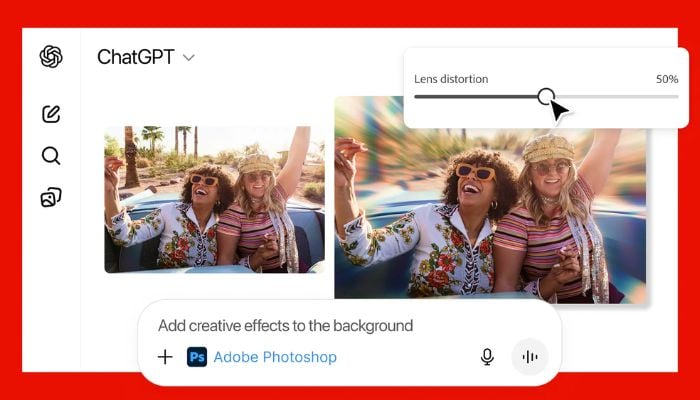
ChatGPT has entered a new phase of growth in AI-powered creativity as Adobe Photoshop, Adobe Express, and Adobe Acrobat are now available for free inside ChatGPT, giving users access to powerful editing tools without needing any professional design skills.
This new integration blends Adobe’s industry-leading creative suite with ChatGPT’s natural-language abilities, allowing users to edit images, design content, or manage PDFs simply by describing what they want.
Adobe Photoshop in ChatGPT
Users on ChatGPT will be able to upload an image and have Photoshop automatically fulfil requests such as “Make this black and white,” “Improve brightness,” and “Remove background.”
The AI then presents adjustment sliders with regard to intensity, exposure, and effects that allow creative control over the images.
The feature will be useful for new Photoshop users because it will be easy for them to navigate and control. At the same time, it will be useful for professional Photoshop editors because it will enable them to make quick adjustments
The launch will improve ChatGPT as a productivity platform and will be attractive for creatives, students, businesses, and designers looking for AI creative solutions.
Adobe Express helps make creative work possible within ChatGPT. It allows designing posters, flyers, and social media postings, as well as user-editable templates based on simple commands.
Simultaneously, Adobe Acrobat brings additional functionality with regard to editing and merging PDFs within the chat, assisting with document finalisation.
Industry experts have pointed out that Adobe Acrobat may alter how creative workflows will function because more and more people are leveraging AI capabilities for assistive functions.