Dec 31, 2025
Artificial intelligence (AI) dominated headlines and timelines in 2025, shaping both the software and hardware we rely on. From GPT-5’s advanced reasoning to Google’s Nano Banana Pro, and from AI-powered smartphones to smart glasses that understand context, the year saw technology that could think, create, and assist in ways previously confined to science fiction.
What made 2025 unique wasn’t just the number of AI releases; it was how integrated and practical they became. AI moved from experimental labs to tools and gadgets people could use daily, powering content creation, productivity, and immersive experiences in ways that seemed futuristic just a year ago.
Top AI models in 2025
Gadinsider has got you the list of the top AI models in 2025
GPT-5 (OpenAI)
OpenAI is an extremely advanced language model that possesses deep reasoning capabilities, thereby enabling the automation of multi-step tasks. It is beneficial for creating texts, code, insights, summaries, or plans. Complex problem-solving is also possible with this model, which works as a virtual assistant.
Gemini 3 / Nano Banana Pro
Text and image generation capabilities. Gemini 3 offers search-level assistance and understanding for both text and image generation, whereas the role of Nano Banana Pro is focused on photo conversion into 3D images and fun edits on social platforms.
Claude 4 (Anthropic)
An AI model for reasoning and multimodal applications, created to produce quality content and execute complicated analysis. It is beneficial in business, research, and creative tasks; it understands subtle inputs and is adept at multiple turns in a conversation.
Runway Gen-4.5
A cutting-edge AI video production model with the ability to generate cinematic-grade videos. It can help video creators, production companies, or marketers produce realistic video content without seeking traditional filming or editing.
Alibaba Qwen3-235B
Giant AI model for superior coding and writing in extensive scenarios. It will be ideal for business organisations and developers in need of language support and logical writing.
DeepSeek-Prover-V2 (DeepSeek)
Reasoning AI for mathematical problem-solving, logical inquiries, and structured tasks. It can be beneficial in research, academic, or development environments that demand high accuracy in computation and reasoning.
Mooshot AI Kimi K2 Series
Trillion-parameter mixture-of-experts AI model with large context understanding. Application in large-scale reasoning tasks, deep contextual understanding, and dealing with complex tasks in research-related, content-writing, and problem-solving projects.
LTX Studio
Open-source text-to-video model for making long-form videos with 4K resolutions. Works well for content creators, marketers, teachers, and story narrators who need fast text-to-video solutions with high-quality video story outputs.
Manus AI
Self-sustaining AI agent that can accomplish real-world tasks and assist users in complicated workflows. Works well with repetitive tasks, those that involve multiple operations, and incorporating AI with daily productivity applications.
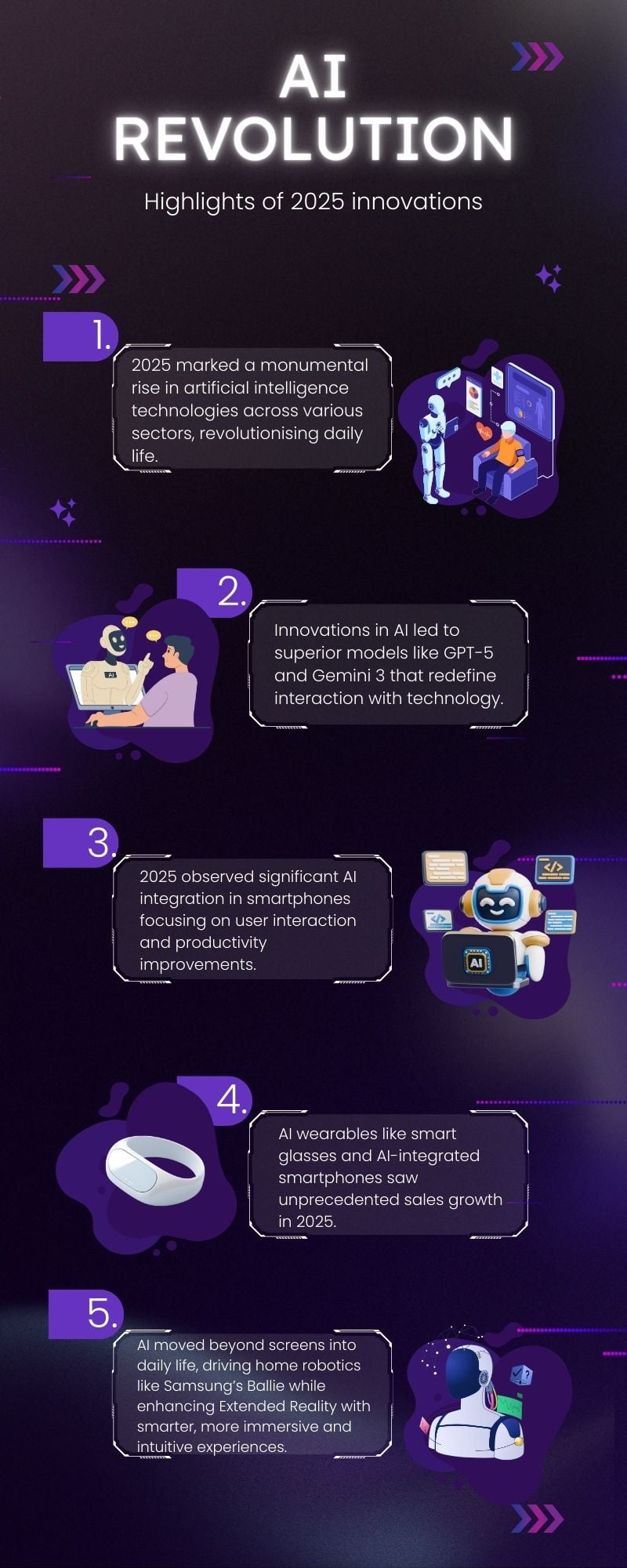
AI integration in smartphones: 2025 year in review
Here’s a look at the smartphones that led the way in AI integration and set trends in 2025.
Samsung: Galaxy AI integration
In early 2025, the Galaxy AI brand from Samsung became a context against which all other phone manufacturers were measured. At Mobile World Congress in 2025, a grand vision was presented that covered more than just voice assistants. An entirely new ecosystem, linked through Samsung’s phone series, software, healthcare, connectivity, and even XR devices, was promised.
The Samsung Galaxy S25 line, comprised of the S25, the S25+, the S25 Ultra, and the S25 FE, was the AI flagship lineup that made an appearance. It was chock-full of tools such as:
- AI select for cross-app text and task pull
- Live translation in all languages
- Writing assist and summary tools
- Photos and videos for generative editing purposes
- ProVisual Engine for professional-level image enhancements
In the background, what powered the smartphone cameras is the ProVisual Engine, also known as Samsung’s AI image system, which utilised AI image learning in a way that improved cameras, scene understanding, and AI-driven edits, sometimes making it difficult to distinguish between a professional photograph and those taken by a smartphone.
However, what’s more significant is that Samsung's strategy in the S6 didn't only involve incorporating more functionalities; it focused on making these functionalities “intelligent” by seamlessly integrating them into people's daily lives using the smartphone.
Apple Intelligence
If Samsung's strategy was broad and expansive, Apple's was measured, interoperable, and privacy-centric. Throughout 2025, Apple doubled down on its Apple Intelligence initiative, a suite of AI capabilities integrated across the iPhone, iPad, Mac, and wearables.
Some of the most notable upgrades included:
- Visual Intelligence: contextual understanding of content by Photos, Notes, and search.
- Smart summaries and translations across Messages and FaceTime;
- On-device neural processing with a focus on user privacy, and
- Siri that finally felt like a context-aware helper and not a command interpreter.
Most of the processing was done on the device with Apple's chips, namely the Neural Engine, keeping personal data closer to the user. This resonated with those consumers wary of cloud, only AI models-and all the attendant concerns over data privacy, making Apple's AI narrative about confidence and continuity rather than sheer capability.
Google Pixel and Gemini expansion
In contrast to the broad-based ecosystem approach that Samsung adopted in its AI, Google in 2025 was placing all its bets on the intelligence within, particularly with its Google Gemini AI technology.
The feature, first launched in 2024, spread to Android gadgets by the end of 25 and has since become an integral mechanism in all AI-based interactions on Pixel smartphones and chosen Samsung models.
Later in the year, Google announced the replacement of the existing Google Assistant with an advanced version of Gemini on Android in 2026, indicating a paradigm shift in the relationship of billions of gadgets with AI.
Honor, Xiaomi and Chinese Original Equipment Manufacturers (OEMs)
The integration of AI technology was not exclusive to Western or South Korean corporations. Chinese brands such as Honor Xiaomi also made headlines.
At Snapdragon Summit 2025, Honor launched its “Dual Engine” AI generation that included products such as the Magic 8 Pro, supporting on-device semantic image editing, smart gaming optimisations, and more.
Xiaomi, known for years as a value-tier tech innovator, has continued its efforts to integrate more AI technologies. Their AI glasses have seen extremely popular sales, breaking over tens of thousands in under a week, which caused initial production estimates to be increased.
AI-integrated wearable
If 2023 was about assistant voices in phones, 2024 was all about assistant voices in phones, and 2025 is all about AI in wearable tech. Tell a friend, “I saw it on my glasses,” and you’ll no longer be speaking about science fiction but about products launched or used, by millions of people.
Meta Ray Ban display
Perhaps the most visible example of this trend was the launch of the Meta Ray Ban Display, smart glasses with a built-in augmented display layer powered by Meta’s AI. These glasses didn’t just show notifications; they could project visual cues, navigation steps, live translations, and interactive content into the wearer’s field of vision.
Launched in late September 2025, the Ray Ban Display represented a fundamental shift: wearables were no longer passive notificators, they became contextual AI interfaces.
Complete with camera capture, translation features, and private messaging displays, they offered a glimpse into how AI could blend seamlessly into the real world without a phone screen as the only medium.
Alongside the Display model, Ray Ban Meta (Gen 2) got iterative software upgrades throughout the year, enhancing battery life, responsiveness, and user utility without changing hardware.
Alibaba wearable
Chinese tech giant Alibaba joined the fray with Quark AI glasses: competitively priced, with features like live translation and price recognition tied into Alibaba's broader app ecosystem.
This segment brought into light a bigger pattern: AI wearables were not just about AR for immersion but AI for everyday utility. Whether recognising objects, helping translate in real time, or augmenting e-commerce interactions, AI in wearables was now practical and not just aspirational.
Emerging entrants like HTC’s VIVE Eagle smart glasses also leaned into openness to let users pick their preferred AI backbone: Gemini, OpenAI, or whoever. This approach certainly helped push the agenda of flexibility in the market.
Robots and XR expansion in 2025
This year wasn’t just about screens and spectacles.
Samsung teased home robots like Ballie, an autonomous assistant designed to integrate with SmartThings, respond to voice, manage smart home functions, and even follow users around with friendly interaction, a reminder that AI’s reach is moving into physical spaces and home life.
Meanwhile, Android XR, a collaborative extended reality operating system developed by Google and Samsung, launched in October 2025, intended to support future head worn computing and immersive experiences with Gemini AI built in.
AI in 2026: Rumours and predictions
- Google smart glasses: Two new AI-powered glasses could provide real-world assistance sans phone.
- Apple Siri: Redesign Siri to handle multi-step tasks with deeper context, understanding of relationships, and integration with third-party apps.
- Samsung AI ecosystem: Integration of AI will see an increase in phones, home appliances, and possibly even AI-only smart glasses.
- LG CLOiD Robot: A robot with human-like arms and AI interaction might make household chores easier.
- AI infrastructure: Alphabet's acquisition of Intersect may support massive expansion in its infrastructure capacity to meet the demands of AI training.
- Screenless interfaces: The world may become less reliant on screens with the help of such innovations as wearable AI rings, robotaxis, and voice-first devices.
- Chip and supply pressures: Stronger AI chip demand would be likely to affect the prices and supply of gadgets in 2026.