Jan 01, 2026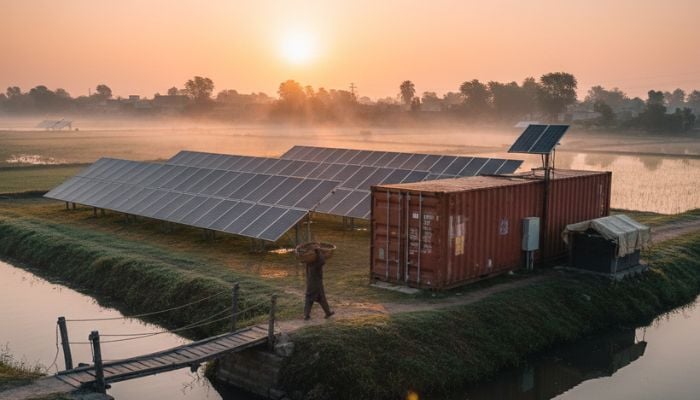
As 2025 comes to a close, climate technology no longer feels like a niche corner of innovation driven by idealists and early adopters. This year was definitely the point at which climate tech transitioned into becoming infrastructure.
Climate tech supported power transportation, monitored emissions, sustained lives, and changed how governments, corporations, and society perceived themselves in a warming world.
Electrification of vehicles is becoming the norm rather than the exception, carbon removal facilities are scaling beyond pilot projects, and AI applications in flood prediction, smart grids, and ag optimisation.
The year also saw a growing impact of climate change in the form of heatwaves, floods, and droughts, primarily in developing climate-vulnerable nations like Pakistan, in which technology emerged as a potential solution not only for mitigation but also for adaptation.
Globally, the momentum continued to build for COP30, where the focus remained on financing, transfer of technology, and accountability.
Meanwhile, for Pakistan, the significant developments were obvious but relatively quiet: a solar surge remaking the energy landscape, the advent of electric mobility, and a new crop of startups focusing on addressing local issues through global solutions in the realm of climate change.
From promise to practice: Climate tech comes of age
For years, climate tech had existed in the realm of prototypes and pitch decks. In 2025, it entered the world of real-world deployment at large-scale levels. One of the ways it became most apparent was in investment trends.
Although overall venture capital investment had been conservative compared with peak levels, climate tech investment had become more focused on areas that demonstrated the ability to cut emissions.
Carbon accounting software, grid management systems, and energy storage systems were big hits because companies were under growing pressure regarding accurate disclosure of their emissions.
Simultaneously, carbon removal, which has historically been accused of being very hypothetical, turned a corner toward industrialisation as the number of direct air capture projects increased.
"The climate conversation can’t be distilled to ‘this technology, this innovation, this breakthrough’," Linked Things CEO Sophia Hasnain told Gadinsider.
“In my view, there are three areas of utmost importance to the issue of climate, and these are resilience, finance, and adopting a lifestyle that mitigates the negative impact of climate change,” she added.
Hasnain says resiliency is, however, the most imperative worry for regions at risk due to climate. Regions such as Pakistan were, moreover, exposed to climate-related disasters in the year 2025.
Beyond resilience, the issue of financing turned out to be one of the hottest sectors of climate tech in 2025, particularly with the accelerated growth of carbon markets in developing countries.
“From the funding perspective, carbon credits have also been mentioned, although at the current level, they mainly exist without the required monitoring and evaluation systems,” she stated.
Electric mobility: Most visible climate shift of 2025
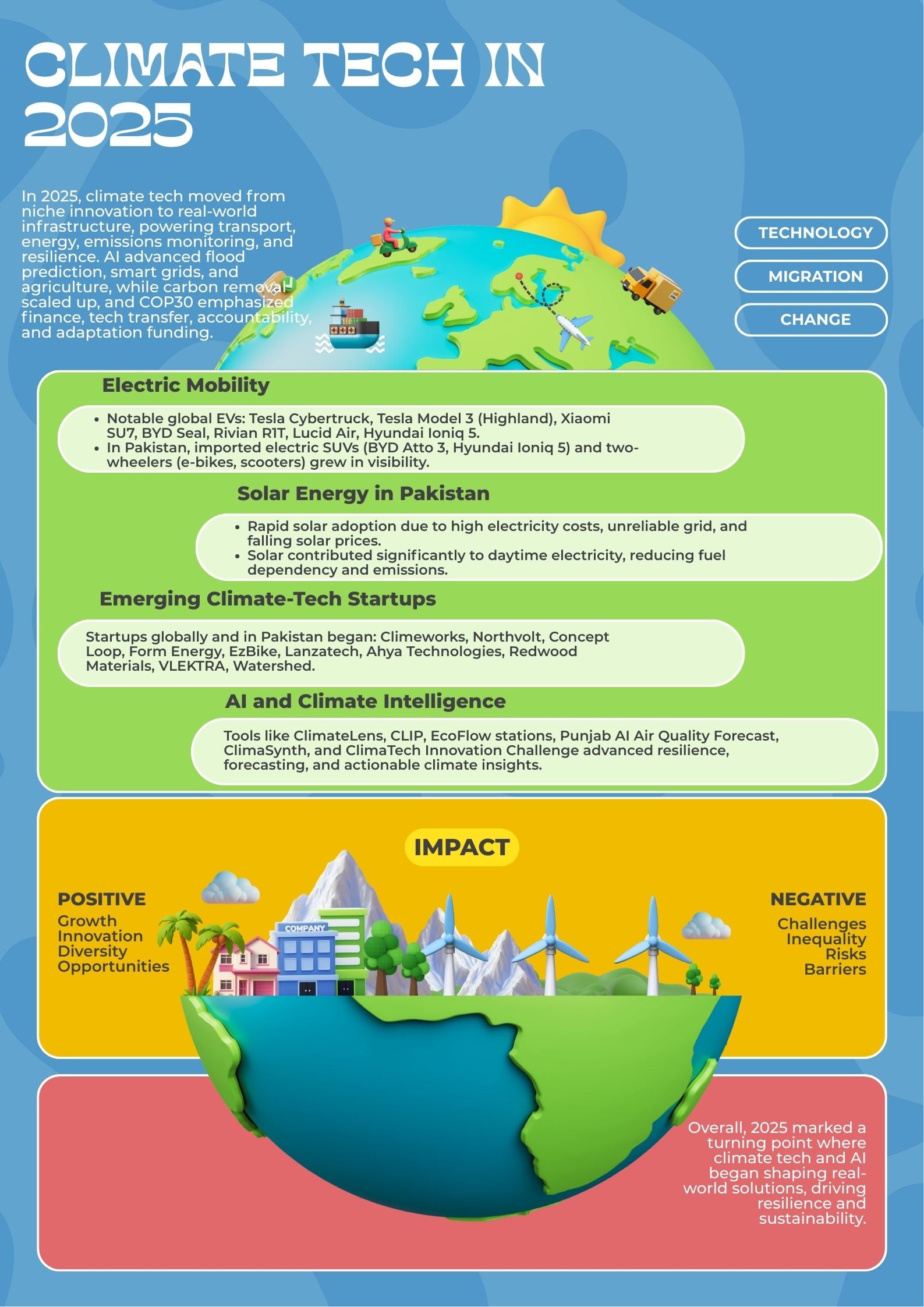
Nowhere was climate tech more visible to consumers than in transportation. Electric vehicles dominated climate conversations throughout the year, both globally and in Pakistan, as falling battery costs, improved charging infrastructure, and expanded model ranges pushed EVs into the mainstream.
Globally, EVs accounted for a significant share of new vehicle sales in 2025, with China, Europe, and parts of Asia leading adoption. New models launched during the year focused less on novelty and more on practicality, longer range, faster charging, and software-driven efficiency.
Vehicles like Xiaomi’s SU7 symbolised a new era where consumer electronics companies entered mobility with data-centric, highly connected EVs offering ranges exceeding 800 kilometres in certain variants. Meanwhile, established automakers refined their offerings, making EVs more accessible across price brackets.
In Pakistan, while mass adoption remains constrained by cost and infrastructure, 2025 marked a clear turning point. Imported electric SUVs such as the BYD Atto 3 and Hyundai Ioniq 5 gained visibility on urban roads, while two-wheel electric mobility quietly expanded.
E-bikes and electric scooters emerged as one of the most practical climate tech solutions for Pakistani cities, offering lower running costs, reduced air pollution, and resilience amid fuel price volatility.
Globally viral EVs in 2024–2025
- Tesla Cybertruck
- Tesla Model 3 (Highland refresh)
- Xiaomi SU7
- BYD Seal
- BYD Atto 3
- Rivian R1T
- Rivian R1S
- Lucid Air
- Porsche Taycan
- Hyundai Ioniq 5 N
- Volkswagen ID. Buzz
- Tata Nexon EV
- Tata Harrier EV
- NIO ET5
- NIO ET7
Pakistan’s solar boom: Climate tech by circumstance
If electric mobility represented aspiration, solar energy represented reality. In 2025, Pakistan had one of the fastest solar adoptions in the region, not because of some aggressive climate policy, but because of structural energy challenges.
High electricity tariff, unreliable grid supply, and falling solar panel prices pushed households, businesses, and even small industries towards distributed solar solutions.
Until recently, this was the solar boom that turned Pakistan into a very unlikely climate tech case study. By mid-2025, a significant chunk of daytime electricity generation in the country came from solar, considerably decreasing dependence on imported fuels and, subsequently, cutting emissions in the absence of a comprehensive national renewable transition plan.
The rapid uptake also exposed gaps: a shortage of trained installers, inconsistent quality standards, and grid integration challenges all made painfully obvious that hardware wasn't enough to support climate infrastructure. This is where ecosystem initiatives began to matter.
Startups and systems: Pakistan’s emerging climate tech ecosystem
Although the Pakistani startups scene remains predominantly fintech and e-commerce oriented, there was a slow start to the emergence of climate-centric initiatives in 2025.
Startups in the climate-tech space, during the year, have addressed uniquely local issues such as inefficient farming, the management of water, waste, and energy. Agri-tech platforms that make use of data in the optimisation of irrigation and fertilisers have become popular, especially due to unusual weather cycles.
The waste-to-value start-ups tried to utilise plastic as well as organic waste in order to produce construction materials as well as fuel alternatives. The energy start-ups concentrated primarily on the improvement of solar energy, battery management, and microgrids instead of energy generation.
Top 10 climate-tech startups of 2025 (Global and Pakistan)
- Climeworks: The direct air capture technology pioneer that is commercialising its
- Northvolt: A lithium-ion battery cell manufacturer that is promoting the adoption of electric vehicles
- Concept Loop: Recycles plastic waste into sustainable building materials.
- Form Energy: Energy solutions for long-duration grid stability through renewable energy sources.
- EzBike: An electric bike sharing and battery swapping solution for changing the
- Lanzatech: Converts industrial emissions into biofuels and
- Ahya Technologies: AI Platform Based on Carbon Emissions Tracking and Net Zero.
- Redwood Materials: Solutions for recycling electric vehicle batteries and providing a circular material supply.
- VLEKTRA: Electric motorcycle company developing green mobility
- Watershed: Carbon accounting and corporate climate data platform.
AI, gadgets, and climate intelligence
Artificial intelligence played a contradictory role in climate tech during 2025. On one hand, AI’s energy and water footprint raised concerns. On the other hand, AI became indispensable for climate resilience.
Here are the top ten highlights from 2025:
- ClimateLens™ (ClimateAi): A real AI‑powered climate resilience platform providing hyper‑local climate risk insights and forecasting for businesses and agriculture.
- Climate Innovation Pakistan (CLIP): Pakistan’s national climate tech platform advancing clean energy innovation and startup support.
- EcoFlow DELTA Pro Portable Power Station: A high‑capacity clean energy storage system used globally for backup and solar integration (well‑known in clean energy hardware circles).
- EcoFlow RIVER 2 Pro Portable Power Station: A compact clean energy generator with fast solar charging, popular among home and outdoor users.
- Punjab AI‑Based Air Quality Forecasting System (Pakistan): A real AI tool deployed by the Punjab government to forecast smog and air pollution months ahead using AI insights.
- ClimaSynth: Pakistan’s first AI‑powered climate insights platform that translates complex climate data into practical, actionable guidance.
- ClimaTech Innovation Challenge 2025: A real global climate tech competition supporting climate and energy startups with AI‑enabled evaluation and investor matchmaking.
Policy, programmes, and the COP30 effect
COP30, which took place in the Brazilian city of Belém, was a turning point for climate action, shifting its attention from promises made at previous conferences to the implementation of these promises.
This conference launched the "Belém Political Package." This package had the 'Global Implementation Accelerator.' This would facilitate the implementation of their climate action plans. There was also a two-year climate finance program for vulnerable regions.
Financial commitments with the aim of tripling adaptation funding by 2035 led to increased investment opportunities for climate-tech innovation, such as in renewable energy sources, resilient agriculture, and disaster risk reduction.
Nature-based solutions, such as the “Tropical Forest Forever Facility,” also made appearances at COP30. The issue of just transition also made its way onto the agenda at COP30.
Nations' Determined Contributions (NDCs) reflected increasing ambition, with a high correlation of targets on renewable energy, carbon capture, and adaptive goals to economic plans.
There was also reinforcement of support for startups in innovation pavilions, multi-stakeholder programs, among other initiatives, through COP30, to ensure that there was practical implementation by 2026.
For Hasnain, climate financing credibility is dependent on creating a system to track and validate claims of climate impact. She fears that without this, climate financing could be relegated to mere performance.
The mitigation efforts and lifestyle change contribute towards the third dimension of addressing the issue, which Hasnain feels is often underestimated. Though such projects on a macro scale are widely discussed and demanded within policies, on the consumer scale, such adoption is equally essential, Hasnain states.
"In terms of adaptation and mitigation through lifestyles, what is required is a promotion of solar energy and electric vehicles," she said. "At the same time, there is a critical need to assess consumption levels and encourage more sustainable lifestyles.”
Hasnain finds beneath these three pillars that there is one essential element that binds them all together, and that is data, as data is what will drive climate change solutions forward. Whether it is an "early warning system, finance, or consumer engagement", data will "separate the solutions from the solutions that will fail."
“In terms of resilience, finance, and mitigation, it's the data that matters most,” she added.
She also correlates the climate data with the economic future of Pakistan and specifically with the growing need of the international market to provide evidence of sustainable manufacturing. The government has emphasised the nurturing of exports; however, the level of utilisation of sound sustainability data has been described by Hasnain as underdeveloped.
Globally, for her to remain competitive, Pakistan will have to prove its compliance with the environmental standards using data verification systems.