Business Desk
  Dec 26, 2025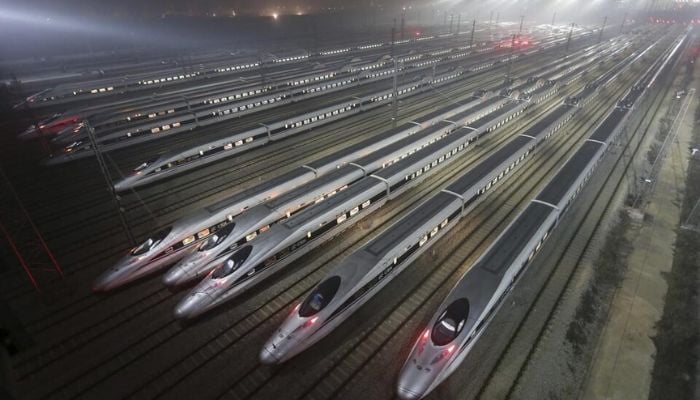
China’s high-speed rail network has crossed a major milestone, surpassing 50,000 kilometres of operating track following the opening of a new rail line on Friday, state media reported.
According to state-owned China Central Television (CCTV), the route connects Xi’an and Yan’an in the Shaanxi province in the north of the Chinese mainland.
Xi’an is a city renowned for the Terracotta Warriors. On the other hand, Yan’an is historically important, as it served as a revolutionary base during the Chinese Civil War. The route covers a distance of 299 kilometres and takes only 68 minutes.
With this addition, the Chinese high-speed rail system has now grown to be a fifth shorter than the Earth’s circumference. This shows the speed at which infrastructure development has happened in the country. The Chinese rail system has been reported to have grown by 32% ever since 2020.
The trains running on the route between Xi’an and Yan’an are capable of speeds of 350 km/h, which is faster than Japan’s fastest train, the Shinkansen, which has a speed of 320 km/h. Even at high speeds, the train is expected to improve travel time significantly between the two cities.
Construction of the line started in 2020 and entailed massive land acquisition. Previously, local authorities stated that homes were demolished to make way for the construction of the line and that each affected family received 5,000 yuan to help them relocate.
Beyond its borders, China has also been exporting its rail expertise. Through the Belt and Road Initiative, Beijing has financed and built railway projects across Asia and other regions, positioning high-speed rail as a key part of its global infrastructure strategy.